Nuclear vs. coal cooling towers: telling them apart in satellite imagery
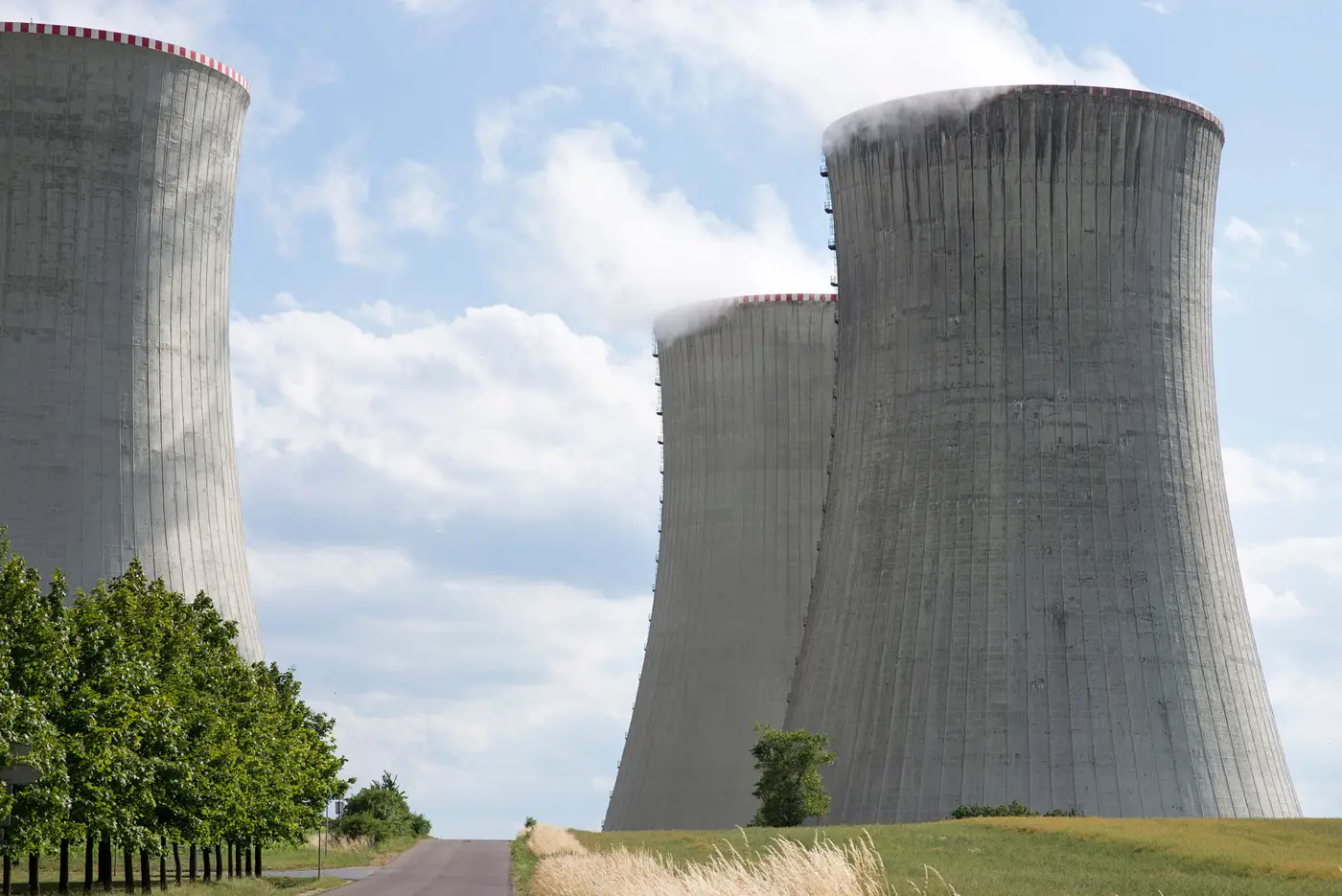
Pull up a hyperboloid cooling tower in satellite imagery and the shape tells you nothing about what's generating the heat underneath it. Nuclear stations use natural-draft towers. So do a lot of large coal units, especially the ones built in the 1970s and '80s with once-through water constraints. If you're trying to ID a plant from a single frame and you're keying off tower geometry alone, you'll misclassify units all the time.
The tower isn't the tell. Everything around it is.
The coal pile is the giveaway, not the tower
A coal plant has to store fuel on-site, usually 30 to 90 days of burn depending on the utility's contracting strategy and how exposed the plant is to rail disruption. That shows up as a dark, often terraced stockpile near a rail loop or barge unloader, with a stacker-reclaimer running a visible track line down the middle. You'll also see conveyor galleries running from the pile to the boiler house, and in a lot of older plants, an ash pond or dry ash landfill somewhere on the property.
Nuclear sites don't have any of that. No coal pile, no rail spur built for unit trains, no conveyor structure. What you'll see instead is a containment building, either a dome or a cylindrical shield building, sitting apart from the turbine hall, plus a switchyard that's usually oversized relative to the visible footprint of the plant because nuclear units tend to run at high capacity factor and push more power out at once.
If there's no fuel pile and no rail loop feeding one, you're not looking at a coal plant. That single check eliminates most of the ambiguity before you even get to the stack.
Stacks, plumes, and what they tell you
Coal plants have flue gas stacks, usually tall, narrow, and separate from the cooling towers. In VHR imagery you can often count them: a two-unit coal plant frequently has two stacks or one shared stack with visible breeching. The flue gas plume off a coal stack carries combustion byproducts and tends to read with more texture and sometimes a faint color cast compared to pure steam, especially before scrubber retrofits, though modern FGD systems have made this harder to read by eye.
Nuclear plants don't have a combustion stack at all. The only plume you'll see is water vapor off the cooling tower itself, and because nuclear units reject more waste heat per unit of electrical output than most coal units, that plume is often larger and more persistent, visible on days when a comparably sized coal plant's tower plume has mostly dissipated. Thermal band imagery makes this clearer still: a nuclear plant's cooling water discharge and tower cluster usually run hotter and more continuously than a coal plant cycling output across the day.
One more plume note: plume presence or absence is a snapshot of operating state, not identity. A coal plant down for a scheduled outage won't show a plume either. Don't let a quiet tower on one pass talk you out of what the site layout already told you.
Put the checks in order
Work it in this sequence and you'll rarely get it wrong: fuel pile and rail loop first, containment structure or absence of one second, stack count and plume character third. Tower shape goes last, if at all.
Once you can tell the two plants apart reliably, the harder question is whether either one is running this week, and that's a different problem than classification. Coal pile volume draws down and refills on its own schedule, stack plumes come and go with dispatch, and none of it shows up in EIA filings until well after the fact. Power Plant Activity turns those same stack, cooling-water, and coal-pile signatures into a weekly nowcast for a named plant, so you're not waiting on a lagging disclosure to know what a unit actually did.
If you're tracking a specific plant's activity week to week rather than just identifying it, that's worth a look.